

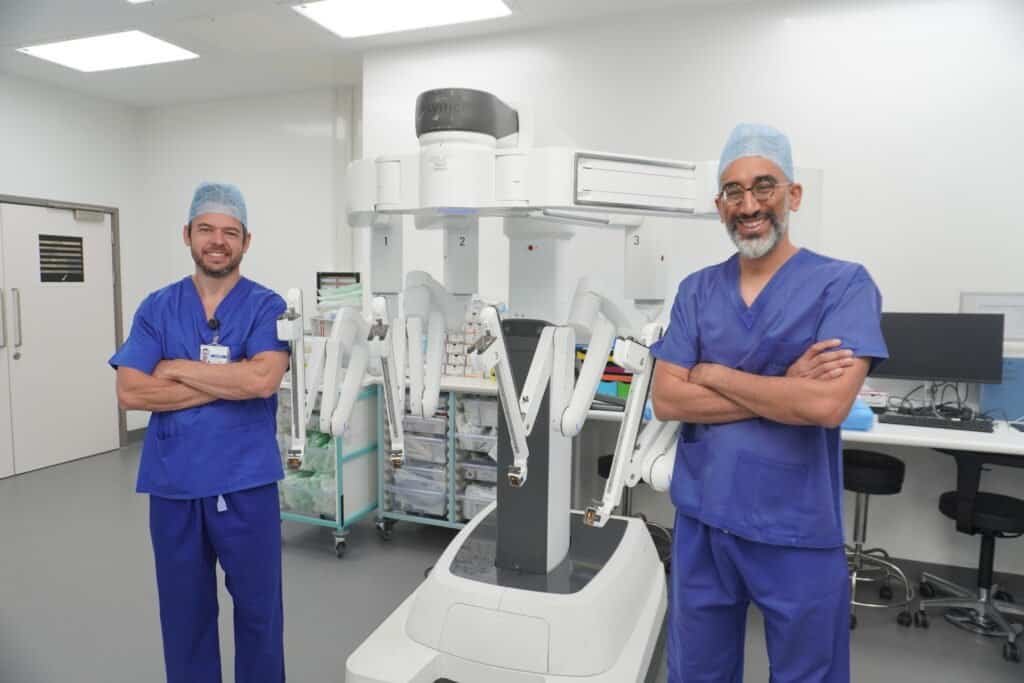
If you have been diagnosed with prostate cancer and are exploring private treatment options in London, you will almost certainly hear about robotic prostatectomy (robotic‑assisted radical prostatectomy). This keyhole operation uses a robotic system controlled by an experienced surgeon to remove the prostate, aiming to cure localised cancer while minimising side effects such as incontinence and erectile dysfunction.
In private practice, you may benefit from shorter waiting times, more flexible scheduling, and the option to choose a surgeon and hospital based on their robotic case volume and outcomes.
What is robotic prostatectomy?
Robotic prostatectomy is an operation to remove the prostate gland and usually the seminal vesicles using a surgical robot, most commonly the da Vinci system.
The robot does not work on its own. Your consultant surgeon sits at a console in the same theatre and controls the robotic arms, which hold a high‑definition 3D camera and precision instruments inserted through small keyhole cuts in your abdomen.
How it differs from open surgery
Traditional open radical prostatectomy uses a single larger incision in the lower abdomen. Robotic‑assisted laparoscopic prostatectomy instead uses several small incisions, typically 5-6, to access the prostate.
Compared with open surgery, the robotic approach offers:
- Magnified, high‑definition 3D visualisation of the prostate and surrounding structures
- Wristed instruments with a greater range of motion than the human hand
- Enhanced precision for delicate work around the nerves and urethra
Large studies suggest that, in expert hands, robotic prostatectomy achieves similar cancer control to open surgery, with less blood loss, shorter hospital stays and faster early recovery.
Is robotic prostatectomy right for me?
Who is suitable in private practice?
Robotic prostatectomy is typically offered to men with localised or locally advanced prostate cancer where surgery is an appropriate curative option.
You may be a candidate if:
- Your cancer is confined to the prostate or just beyond the capsule
- You are fit for a general anaesthetic
- You prefer a surgical route after discussion of all evidence‑based alternatives
In private practice, your urologist will still follow national and international guidance (NICE, EAU) when recommending surgery versus radiotherapy, brachytherapy, focal therapy or active surveillance. The key difference is that you have more control over where and with whom you have treatment, and often a shorter time from decision to surgery.
Nerve‑sparing in robotic prostatectomy
One of the main technical decisions is whether a nerve‑sparing approach is safe. The nerves and blood vessels that control erections run in “bundles” alongside the prostate.
- If the tumour is away from these bundles, your surgeon may preserve one or both sides (unilateral or bilateral nerve‑sparing).
- If the cancer is close to or involving the nerves, removing more tissue may reduce the risk of leaving cancer cells behind.
Your MRI, biopsy and examination findings, together with your priorities around erections and cancer control, guide the plan. In private practice, you can ask specifically about your surgeon’s nerve‑sparing rates and typical functional outcomes.
Benefits and risks of robotic prostatectomy in private care
Potential benefits
In experienced UK centres, robotic prostatectomy offers several advantages over open surgery:
- Smaller scars and less soft‑tissue trauma
- Reduced blood loss and lower transfusion needs
- Shorter hospital stay (often 1-2 nights in private units)
- Faster early mobilisation and return to light activities
Oncological outcomes (clear margins, PSA control) are comparable to open surgery where surgeons are appropriately trained and operating at volume. Long‑term continence and erectile function depend on age, baseline function, disease extent and the feasibility of nerve‑sparing, not just the robot itself.
In a private setting you may also benefit from:
- A choice of consultant and hospital based on robotic case volume
- More flexible operation dates and fewer delays
- Private rooms and enhanced peri‑operative facilities
Risks and possible side effects
Robotic prostatectomy is still major surgery and carries risks such as:
- Bleeding, infection and blood clots
- Anaesthetic complications
- Rare injury to nearby structures (bladder, rectum, blood vessels)
The key longer‑term side effects are:
- Urinary incontinence – most men leak urine immediately after catheter removal; this usually improves over months with pelvic floor exercises, but some need further treatment.
- Erectile dysfunction – erections are universally affected in the short term; recovery depends on pre‑operative function, age and whether nerves can be spared.
High‑volume surgeons and centres tend to achieve better functional outcomes, which is a major reason men choose private robotic surgery with specific teams.
What to expect on a private robotic prostatectomy pathway
Before your operation
In London private practice, the pre‑operative pathway usually includes:
- Detailed consultation reviewing your diagnosis, MRI and biopsy findings
- Discussion of all treatment options (including radiotherapy and focal therapy if relevant)
- Explanation of nerve‑sparing strategy and realistic expectations around continence and erections
- Pre‑assessment for fitness (blood tests, ECG, anaesthetic review)
- Advice on pelvic floor exercises and early mobilisation
You will also receive information about costs, what your insurance covers (if applicable), and available package prices for surgery and follow‑up.
The day of surgery
Robotic prostatectomy is performed under general anaesthetic and usually takes around 2-3 hours in the hands of an experienced team.
Key steps include:
- Several small incisions are made in your abdomen for the instruments and camera.
- The surgeon carefully dissects the prostate and seminal vesicles, and performs nerve‑sparing where safe.
- The bladder is re‑joined to the urethra (vesico‑urethral anastomosis).
- A catheter is left in place to allow healing.
Most private patients are encouraged to sit out of bed and walk with supervision on the same or following day, with a view to discharge after 1-2 nights depending on recovery.
Aftercare and recovery
In a London private hospital, typical recovery milestones are:
- Discharge with catheter in place, plus pain relief and thrombosis prevention
- Catheter removal after 7-14 days in clinic, with immediate continence review
- Gradual return to office‑type work within 2-4 weeks, avoiding heavy lifting for 4-6 weeks
- PSA check around 8-12 weeks post‑op, then regularly thereafter
Good private units also offer access to pelvic floor physiotherapy, erectile rehabilitation (including PDE5 inhibitors, vacuum devices or injections) and psychological support where needed.
Choosing a private robotic prostatectomy surgeon and centre in London
Why experience and volume matter
Outcomes after robotic prostatectomy are strongly linked to surgeon and centre volume – high‑volume robotic surgeons generally have lower complication rates and better continence and erectile outcomes.
Publicly available resources such as Prostate Matters and patient support organisations highlight centres and consultants carrying out large numbers of robotic cases each year. When you are self‑funding or using private insurance, it is reasonable to ask:
- How many robotic prostatectomies do you perform per year?
- How long have you been using the robotic platform?
- What are your continence and erectile function rates at 12 months?
- How often do you perform bilateral vs unilateral nerve‑sparing?
- What is your positive surgical margin rate for disease like mine?
You may also wish to know whether the same consultant manages your full pathway (consultation, surgery and follow‑up) and how quickly you can be scheduled.
How robotic surgery fits with other private prostate cancer options
Surgery, radiotherapy and focal therapy in private practice
Robotic prostatectomy is one of several high‑quality options available in London’s private sector for localised prostate cancer.
Other evidence‑based treatments include:
- Active surveillance – for carefully selected men with low‑risk disease who wish to delay or avoid treatment while being closely monitored.
- Focal therapy (e.g. HIFU, cryotherapy, IRE) – offered in certain centres for clearly localised tumours to balance cancer control with functional preservation.
- External beam radiotherapy (including SBRT) and brachytherapy – often combined with short‑course hormone therapy in intermediate‑ and high‑risk disease.
A strong private prostate cancer service should be able to offer, or work closely with, all of these modalities, so that your choice of robotic surgery is based on preference and evidence – not just local availability.
Key questions to ask before booking robotic prostatectomy privately
Before committing to private robotic surgery, consider asking your surgeon:
• Is robotic prostatectomy clearly the best option for my stage and risk profile, or would radiotherapy/focal therapy be equally appropriate?
• Will you be aiming for nerve‑sparing, and on which side(s)?
• What continence and erectile outcomes should someone like me reasonably expect at 3, 6 and 12 months?
• What does your package include (hospital stay, follow‑up visits, management of early complications)?
• How quickly can I be treated, and what are the implications of any delay?
Having clear answers to these questions will help you decide whether private robotic prostatectomy in London is the right path for you.